
One of the first questions a family asks — sometimes shyly — is how long the puja will take. Behind it sits a quiet worry: that a shorter ceremony is a lesser one, or that a longer one is staged for effect. The tradition answers calmly. The length of a puja is not a measure of its worth; it is a choice of depth, and every classical depth is correct. The question "how long" is really the question "how deep", and the shastras answer both together.
Longer is not better
A puja is validated by two things: the vidhi, the correct order of the ritual, and the sankalpa, the stated intention with which it is begun — who is acting, for whom, and for what purpose. Neither grows with the clock. The shastras themselves provide for worship at several elaborations, which is why the same deity can be honoured in five minutes or five hours and neither is a compromise. What matters is that every step performed is performed completely.
Sankalpa and depth of offering
The sankalpa takes only minutes, and it binds the ritual to the family that requests it. It is worth knowing that the sankalpa is never shortened. Whatever the depth chosen, the intention is stated in full, with the names and the purpose your family gives. This is why a five-minute puja still belongs wholly to the family it was made for. The rest of the length comes from the upacharas, the marks of honour offered to the deity: five, ten or sixteen are the classical depths, and they map almost exactly onto three honest time budgets.
The three time budgets
- About five minutes — panchopachara. Five offerings: gandha (fragrance), pushpa (flowers), dhupa (incense), deepa (flame) and naivedya (food). Right for daily worship, a car puja, or a brief office puja.
- About fifty minutes — dashopachara. Ten upacharas, each with its own mantra. The natural depth for a family sankalp, a monthly puja, or a festival evening at home.
- About five hours — shodashopachara. The full sixteen-fold worship. Chosen for the great anushthans — a Ganesh Chaturthi sthapana, an annual Rudrabhishek — when the family can give the day.
The order of the vidhi is identical at every depth; only the elaboration changes. Each depth is explained fully in our guide to panchopachara, dashopachara and shodashopachara worship.
Common situations, honest choices
A few examples make the point plainly. A car puja before a working morning belongs at panchopachara, and loses nothing by it. A Satyanarayan Katha promised for a household is happiest at dashopachara, complete within an evening. An annual Rudrabhishek or a Ganesh Chaturthi sthapana deserves the full day of shodashopachara. Even a Namkaran or a Mundan can be honoured at the depth the family chooses, from a brief home rite to the fuller form. In each case the family chose a depth; in none was validity in question.
Realistic budgets for homes and offices
Households in Mumbai plan around trains, school runs and building timings, and offices around working hours. None of this is an obstacle. Name the time you have and the vidhi is planned to fit it: a new-office puja completed before the staff arrives, a Satyanarayan Katha that closes before lunch, a Griha Pravesh given the whole morning, unhurried. The one thing never compressed is the order itself — a short puja is complete at its depth, not cut short in the middle.
Completeness, not duration, is what the sacred fire receives — as the shastras remind us.
A request worth making, and one worth not making
It is entirely respectful to tell a purohit the time you have; the tradition expects it. What does not honour the ritual is asking for steps to be skipped inside a fixed depth. Shortening is done by choosing a smaller classical format, never by cutting a larger one in half. A purohit who agrees to skip steps to save time is not saving you time; he is lending your intention an incomplete vessel.
Booking by time budget
When you request an appointment with Acharya Brajesh through the booking page, tell him the time your family or office can give. The puja is then planned to that budget in the Shankaracharya and Vedic paddhati — nothing essential left out, nothing added for show. The timing is settled into the vidhi before the day arrives, so the ceremony ends when it should. The full range of rituals, from five-minute blessings to five-hour anushthans, is described on the services page, or call +91 98679 90291 to speak directly.
Frequently Asked Questions
How long does a typical puja take?
Is a five-minute puja actually valid?
What is a sankalpa?
How long does an office puja take?
Does a longer puja cost more?
Can I book a puja for a fixed window of time?
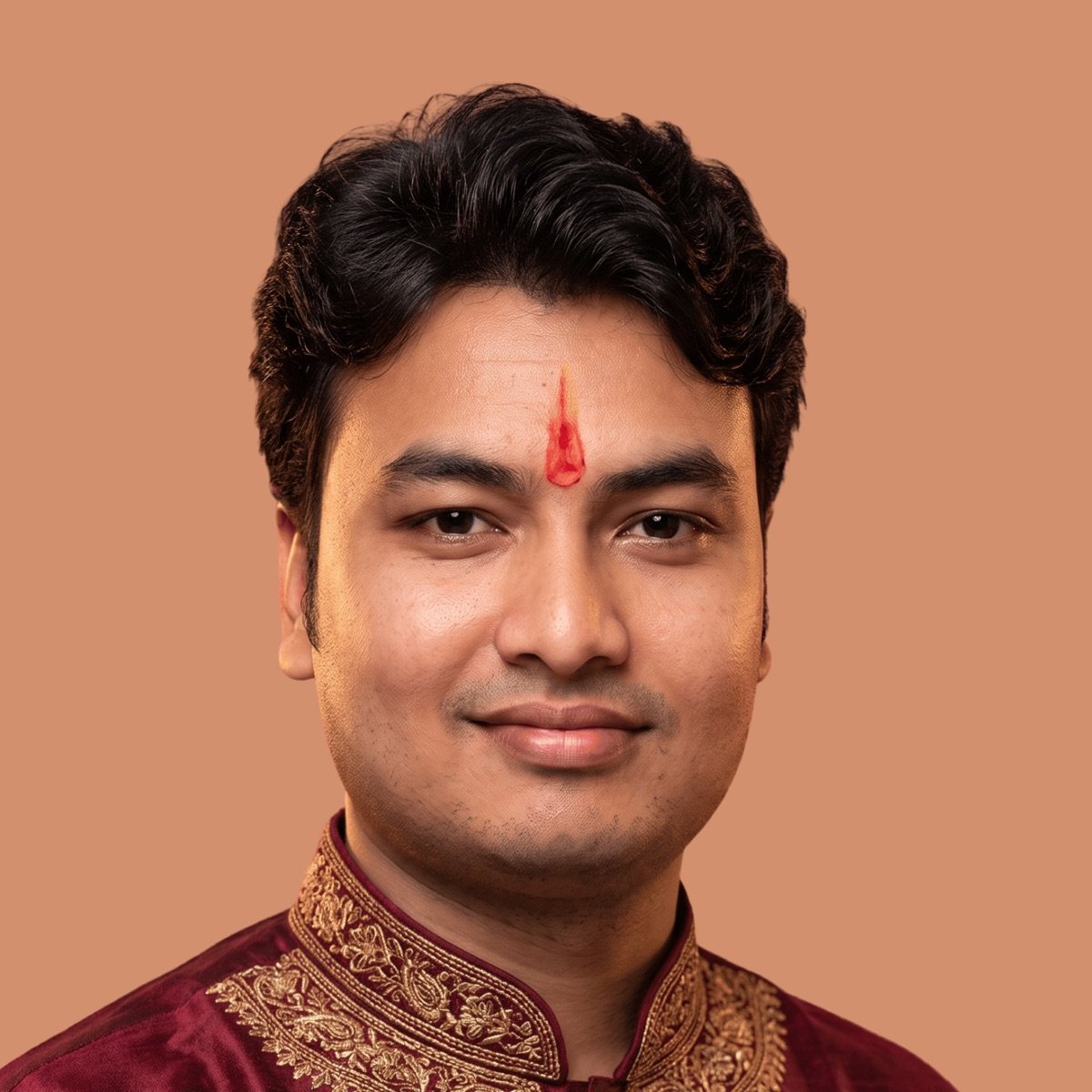
Acharya Brajesh
Vedic Purohit, Andheri, Mumbai. Invited to the USA (2009–11) as a Vedic Pandit by the Maharishi Mahesh Yogi organisation. Every ritual performed per Sanatan Dharma Vedic Darshana — in the Shankaracharya and Vedic paddhati. More about the Acharya →
Have a ceremony in mind?
Describe your requirement, verify your email with a one-time code, and the office will call you to fix the muhurat — anywhere in Mumbai.
Request an Appointment