
Every Vedic mantra sounding in a home today was learned by someone, from someone, across an unbroken chain of teachers reaching back to the seers who first received the Vedas. That chain is the guru-shishya parampara — the lineage of teacher and disciple — and it is not sentimental background to the work of a purohit. It is the mechanism by which a ritual becomes correct.
What the parampara transmits
Books preserve words; a teacher preserves everything around the words. In the parampara a student learns beside the guru over years: where the voice rises, where it rests, how long a syllable is held, when to sit, when to rise, when to offer. The shastras themselves present knowledge as received at the feet of a teacher, and the Grihya Sutras read like working notes for a practice already alive. Nothing in this transmission is casual, and nothing is self-taught.
Swara and matra: why the sound must be exact
A Vedic mantra is not a sentence to be read aloud; it is a sound-structure with fixed swaras — pitch accents — and matras — syllable measures. Change either, and the sound in which the mantra was received changes with it. Tradition holds that a mantra recited without its correct accents loses its force to bless, which is why a student is corrected syllable by syllable, and why he recites for years before he performs for families. This is not perfectionism for its own sake. It is fidelity.
Lineage-verified practice, habit-based practice
Much inherited practice is sound and sincere — a sequence handed from father to son, kept faithfully for generations. That faithfulness carried the tradition through hard centuries, and it deserves respect. But habit and verification are different things. An acharya formed in a parampara can trace each step of a puja to the shastras, explain why the Shankaracharya paddhati orders the worship as it does, and say calmly where traditions differ and why he follows the one he follows. On the day itself, the difference shows as quiet command — fewer pauses of doubt, and answers where a shrug might otherwise stand.
A mantra is a bridge built syllable by syllable; the parampara keeps the plan of the bridge — as the shastras remind us.
How a family can tell
Lineage is not invisible; it can be asked about. Ask a purohit who his guru was, and how many years he studied before he began performing for families. Ask him to explain one step of a ritual he performs often — why Ganapati is worshipped before anything else, why the kalash is established with mantra. A lineage-verified acharya answers with ease and without irritation, because he was taught the reasons, not only the motions. You will hear it also in how he speaks of other traditions — without contempt, and without confusion. The answers become a small teaching for your household, which is exactly what a family purohit is for.
The making of Acharya Brajesh
Acharya Brajesh — Brajesh Kakoriya — belongs to this older world. His roots are in the village of Nandhiri, and he was raised inside the guru-shishya parampara, formed in the rituals of Sanatan Dharma under his teachers from his early years. From 2009 to 2011 he lived in the United States, invited as a Vedic Pandit by the Maharishi Mahesh Yogi organisation and based at Maharishi University of Management in Iowa, where he performed and taught Vedic ritual. An invitation of that kind carries its own verification: an institution examines a lineage with care before it brings a purohit across an ocean. The full journey is told on the about page.
What this means for your family
When a lineage-verified acharya performs your Griha Pravesh, your Vivah, or the yearly Shraddh for your ancestors, you receive a ritual that is not improvised. The mantras carry their correct swaras. The sequence follows the shastras strictly, in the Shankaracharya and Vedic paddhati. And when your family asks why a step is done, the answer arrives as a teaching, not a shrug. The same is true of a Namkaran, a Mundan, or a Satyanarayan Katha: the format changes, the fidelity does not. The rituals performed for households across Mumbai — daily, yearly, and at every turning of life — are described on the services page.
Begin with a conversation
If the correctness of your family's rituals matters to you, request an appointment with Acharya Brajesh through the booking page or call +91 98679 90291. Ask him about his lineage; he will be glad you did.
Frequently Asked Questions
What does guru-shishya parampara mean?
Why does mantra pronunciation matter so much?
Can Vedic mantras be learned from books or recordings?
What is a paddhati?
Where did Acharya Brajesh receive his training?
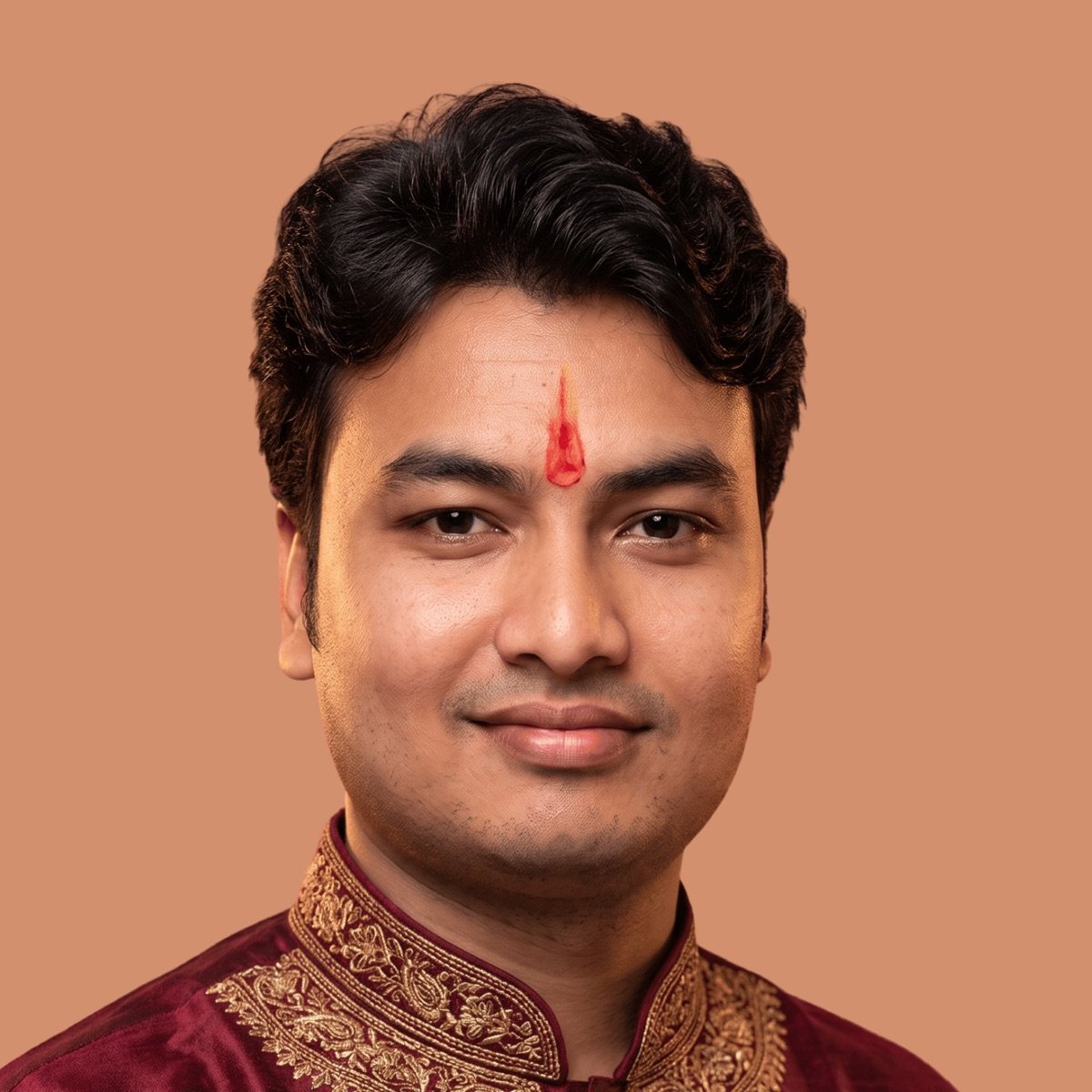
Acharya Brajesh
Vedic Purohit, Andheri, Mumbai. Invited to the USA (2009–11) as a Vedic Pandit by the Maharishi Mahesh Yogi organisation. Every ritual performed per Sanatan Dharma Vedic Darshana — in the Shankaracharya and Vedic paddhati. More about the Acharya →
Have a ceremony in mind?
Describe your requirement, verify your email with a one-time code, and the office will call you to fix the muhurat — anywhere in Mumbai.
Request an Appointment